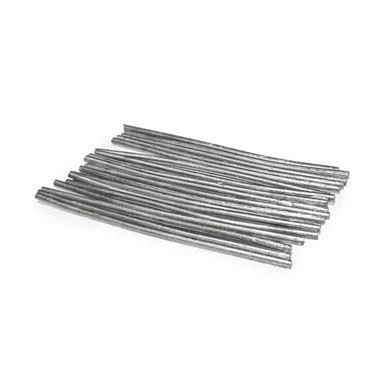
What Is Bismuth Tin
Oct 30, 2021
The low melting point alloy mold with bismuth and tin low melting point alloy elements as the main components and the melting point of about 70~150℃ is suitable for forming various covering parts of large and medium size. The mold making time is about 6~8h. The cost is 60%~90% lower than that of steel molds. The factory only needs to prepare an appropriate alloy frame to meet the forming and processing needs of various covering parts.
Figure 1 shows a schematic diagram of the structure of a typical forming die for an inner hot air pressure water-cooled deep drawing cover. The part with the double-dotted line in Figure 1 is the sample 17, also known as the sample mold, which is the basis for molding. Its shape is roughly the same as the workpiece to be formed, but its thickness should be equal to the mold gap of the forming mold. Additional inner and outer retaining walls for separating formed punches, dies and hemming nets. There are small holes on the sample, so that the molten alloy flows from the outside of the mold into the cavity of the mold to form a punch. Samples can be made by knocking steel plates, pasted with glass cloth, or even pasted with paper pulp and then coated with high temperature resistant glue.
The mold is often used on a special press. Because the melting point of the alloy is very low, the alloy can be melted by the heating tube in the molten pool on the mold. The function of the main molten pool is to melt and solidify the alloy and form a concave mold, and the role of the auxiliary molten pool is to pressurize the surface of the alloy in the main molten pool to be pressurized by the air pressure device to replenish the alloy to the main molten pool, thereby improving the accuracy of the casting mold and improving the mold. Density of internal tissue. In addition, when the molten alloy flows from the outside of the sample to the inner cavity, the inflow speed can be increased by pressurizing, so as to reduce the casting time. There is a cooling water chamber around the main molten pool, its function is to speed up the solidification time of the alloy, reduce the time of mold making, and also make the alloy quench and improve the hardness of the alloy. Screws are installed on the convex plate and the blank holder, and their function is to fasten the alloy. The exhaust pipe is cast in with the mold, and the ejector is placed after the mold.
A steel plate is added to the concave die opening of the mold, because when the cover is formed, the plate at the concave die opening is severely deformed, causing serious wear to the concave die opening, and the addition of the steel plate can improve the service life of the mold. Steel inserts can also be added to the parts where the mold wear is more serious to improve the service life.
For covers with curved flanges, this concave die mouth does not need to add steel plates, and is directly cast from low-melting alloys, in order to reduce the cost of molding, but the service life is low.
Using the molten pool to make the cover forming die, as long as the size of the workpiece is within the size range of the molten pool, the sample can be cast, so the molten pool is universal, and the fixing plate of the punch and the blank holder can also be universal, only if necessary The steel insert is dedicated, so the mold-making cycle is very short and the cost is very low. After a pair of molds is used, a new mold can be cast, and only the samples need to be saved, so the storage space is small.
Due to the low melting point of the alloy, the mold can be cast on a press, eliminating the need to reinstall and adjust the mold. Self-casting die presses have been developed and used at home and abroad, and this press itself is equipped with a molten pool of low melting point alloys. For individual worn mold parts or unsatisfactory parts of the casting mold, ordinary fused iron can be repaired, and the alloy is very soft, so the surface of the workpiece will not be scratched when the cover is formed.